FunstonAntiques.com

Antiques

FunstonAntiques.com header image 1

8) Kassel, a Wunderkammer in the Mind

July 2nd, 2009 · No Comments

Kassel is about 2 hours east of Halle by car. Here the noble family, the Landgraves of Hessen-Kassel, presided over a prosperous community for centuries and, not surprisingly, reflected their good fortune in the family wonder chamber.

img_6010

Their collection was begun by Landgrave Wilhelm “the Wise” (Wilhelm IV who died 1597), continued by his son, Moritz “the Learned” (died 1627), and his descendant Karl in the late 17th century. And in the 1770’s, Landgrave Frederich II sponsored one of the first museums open to the public.

Unfortunately the princely wunderkammer no longer exists, but many of the items remain in the city distributed among the museums there. Thus you must assemble the wunderkammer in your mind by visiting the Ottonium for natural history, the nearby Orangery for scientific instruments and the kunstkammer for art. [Read more →]

→ No CommentsTags: Wunderkammer

7) Francke Cabinet of Curiosities in Halle

June 24th, 2009 · No Comments

Halle is about a 1 ½ hours’ drive northwest of Dresden. This is the home of the Francke Foundation and its cabinet of curiosities and artifacts.
img_59631

Founded in 1698 by Lutheran theologian and educator August Herman Francke (1663-1727), the Foundation was first and foremost an orphanage and secondly a progressive school for all social classes. Thus Francke formed the wunderkammer as a teaching tool. Francke was obviously an effective fundraiser for not only did he raise the money to build the substantial Foundation but also induced people worldwide to provide as gifts most of the almost 5000 items of the collection. [Read more →]

→ No CommentsTags: Wunderkammer

6) The Green Vaults of Dresden, the Grunes Gewolbe

June 11th, 2009 · No Comments

Although only an hour’s drive from our last stop, Waldenburg, the wunderkammern of Dresden are clearly in another world.
img_62151

Despite being firebombed to ruble by the Allies during World War II, Dresden has arisen from the ashes miraculously to its former baroque glory and today houses two, not one, over-the-top wunderkammern. The Historic Green Vaults were designed by Augustus II and opened (very selectively) to the public in 1730. The New Green Vaults contain other princely assets originally housed elsewhere, plus items added after Augustus’s death in 1733. Together they represent Europe’s most magnificent treasury museum, and to the American mind, an embarrassment of riches. [Read more →]

→ No CommentsTags: Augustus the Strong · Curio Cabinet · Funston Antiques · Green Vaults · Wonder Chamber · Wunderkammer · Wunderkammern

5) Waldenburg Cabinet of Natural Sciences

June 3rd, 2009 · 1 Comment

img_5843

About 3 hours by car northeast of Landshut (our last stopover) and say 4 to 5 hours from Munich is the little town of Waldenburg, Germany (formally, East Germany) which houses an appealing wunderkammer, the Cabinet of Natural Sciences. The wunderkammern discussed in the last two chapters in Munich and Landshut were both first-period (pre-1650) and princely. At the other end of the spectrum is this one. Began in the second period (post-1650), this systematically-presented collection was founded by commoners and focused almost exclusively on natural history.

The wunderkammer was founded about 1670 by pharmacist Heinrich Linck (1638-1717) of Leipzig and added to by his son, Johann (1674-1734) also a pharmacist, and in turn by Johann’s son, Johann the Younger (1734-1807). Otto Victor I (1785-1859) prince of Schonburg-Waldenburg, purchased the Linck collection in 1841, moved it to its current location, and significantly added to it. It retains a Victorian character today and occupies over 9 rooms in a sea of glass cabinets. [Read more →]

→ 1 CommentTags: Wunderkammer

4) Chamber of Art & Curiosities, Landshut

May 31st, 2009 · No Comments

img_00031

Installed in the 13th century Trausnitz Castle, overlooking the town of Landshut, about 50 miles northeast of Munich is the wunderkammer begun by the Bavarian Duke Wilhelm V (1548-1626), Duke Albrecht V’s son. When Wilhelm assumed the title of duke in 1579, he moved his whole household including his collection to Munich, joining his wunderkammer with his father’s (see prior chapter). Interestingly in 1597 at the age of 47, Wilhelm turned over the government to his son, Maximillian, and thereafter until his death in 1626 led a life devoted to piety, asceticism, chastity, and the placid enjoyment of his collections of works of art and curiosities (Catholic Encyclopedia on line).

The present collection has been rebuilt based upon archival records. The exhibits are split into 4 sections, naturalia, artificialia, the expected two plus two others, exotica, marvels from foreign lands, and scientifica, scientific tools and instruments. [Read more →]

→ No CommentsTags: Curio Cabinet · Wonder Chamber · Wunderkammer · Wunderkammern

3) Albrecht’s Treasury at the Munich Residence

May 24th, 2009 · 3 Comments

The wunderkammer of Bavarian Duke Albrecht V (1528-1579) was one of the grandest 1st period ones ever built. It housed over 3500 items and was installed over the ducal stables in several rooms, some of which were over 100 feet long (MacGregor, p13-15). Reportedly it consisted of both naturalia and artificialia, and according to contemporary expert, Samuel Quiccheburg, was arranged according to materials (ivory items grouped together, then wood items, etc) (Kenseth, p85). It was very much a microcosm of God’s world, and thus served as a suitable model for Quiccheburg to refer to in his important wunderkammerist’s manual of 1565.

Unfortunately, it was over 95% destroyed by war and voluntary dispersal, and the only vestige today is the collection of precious materials retained by the Bavarian treasury. Fortunately, the items which do remain are well worth a visit.

While the entire wunderkammer before dispersal may well have demonstrated a thirst for universal knowledge, the princely items which remain in the treasury certainly would have inspired the kind of respect and fear that must have favorably impacted Albrecht’s statecraft.

The collection today is placed in 10 adjoining rooms in the Munich Residence in modern, well-lit display cases. Some of these princely objects include:

img_5790
The earliest English Queen crown extant, made about 1575. [Read more →]

→ 3 CommentsTags: Albrecht V · Curio Cabinet · Funston Antiques · Uncategorized · Wonder Chamber · Wunderkammer · Wunderkammern

2) Wunderkammern: Themes, Dreams, and Scenes

May 16th, 2009 · No Comments

Ferrante Imperator, Dell'historia naturale, 1599, the first published image of a wunderkammer

Ferrante Imperator, Dell'historia naturale, 1599, the first published image of a wunderkammer


THEMES
Generally there were few rules governing the creation of a wunderkammer. 1) Be broad in your collecting. These after all were renaissance men. But the impetus to be broad was more than good manners. Consultants in this field back then advised you to be so broad that you were creating a microcosm of the entirety of God’s world. 2) Use symmetry where you can in your display. 3) Heighten the magic of your presentation by juxtaposing unlike objects for dramatic effect. Otherwise, there really weren’t rules…so the collections tended to be a very personal reflection of the owner’s interests…sort of your own 3-D walk-thru sculpture. And no two were alike.

Nonetheless, you can fit them into categories, based on their date founded, contents, and status of the owner [Read more →]

→ No CommentsTags: Curio Cabinet · Dreams & Scenes · Funston Antiques · Introduction · Themes · Uncategorized · Wonder Chamber · Wunderkammer · Wunderkammern

1) Wunderkammer: An Introduction & Preface

May 9th, 2009 · 1 Comment

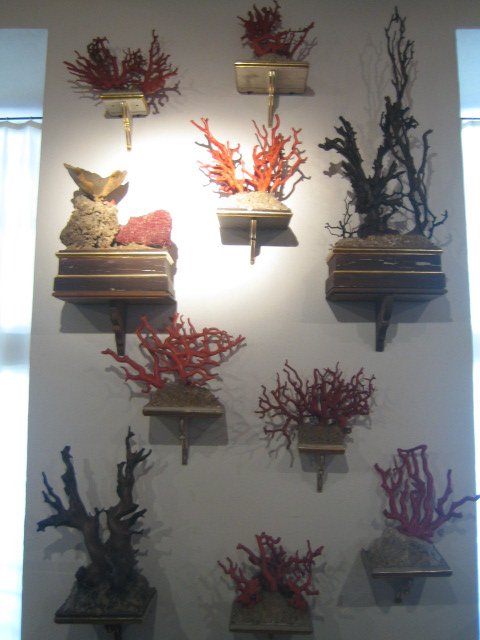
wunderkammer-coral-funston-antiques.JPG
Imagine what Europeans experienced during the age of discovery, roughly 1500 to 1550 AD. New continents were being discovered and the world was being shown to be a far more diverse and complex…and wonderful …place than originally thought. Ships were frequently returning from uncharted lands, their holds crammed full of strange and wondrous new life forms, tribal art, and even the strange looking tribesmen themselves. Meanwhile scholars at home doing their renaissance thing were learning so much…about astronomy, printing, optics, alchemy, medicine, philosophy, art with perspective, etc. This explosion of new insights showed God’s world to be all the more awesome, man all the more capable, and life filled with all the more wonder.

Not surprisingly, noblemen, scholars and merchants went down to the docks and bought this new-world cool stuff… the seashells, the wild plant material, the “unicorn” horns, the feather headdresses… and brought it home. And they added the products of local artisans and artists, demonstrating virtuosity of the highest order…still lives so realistic you had to tap the canvas to find them two-dimensional, turned carvings of incredible delicacy and complexity, classical sculpture so life-like. And all these were placed in purpose-built rooms, wonder chambers or (in German) wunderkammern, which created a microcosm of the whole world right in your home. These rooms were designed to overwhelm you with a sense of wonder, or in modern parlance, to blow your mind.

My purpose here is to promote interest in these wunderkammern (one wunderkammer, two wunderkammern…sorry, German) to the point where the reader will learn about them, consider visiting some, and perhaps build their own. For the world is a wonderful place and we should more often celebrate that fact.

The literature and internet happily are full of information on this topic. And many beautifully illustrated books were produced in the 16th and 17th centuries as well as in the 1980’s ’90’s and ‘oughts. What I found missing was a practical guide to help you visit them in person. And that’s what I propose to write about, visiting them and seeing in person: the cacophony of form, the bouquet of color, the quirkiness, the opulence, and the stimulus for the curious.

While several thousands of these have existed in Europe, most no longer do and finding the ones worth a visit is not a straightforward task…One which took me hundreds of research hours. So I plan to describe an 11-day itinerary which two of us followed in April/May of 2009 taking us to 9 wunderkammern in Germany and Austria for a little over $4000 US including flights from Boston. (I plan to make other trips to other parts of Europe…England, France, Italy and Eastern Europe in time.) I recommend those with the interest make a similar trip!

But wait. There’s a recession/depression going on. There are wars being fought with people dying. What relevance could what renaissance people did up to 500 years ago possibly have today? One thought is that then just as now the steepness in the progress curve is especially pronounced and the explosion in knowledge remarkable. A second is this: back then, Europeans were discovering the rest of the world for the first time. History then shows that a period of European exploitation of these new worlds followed, sometimes being rather hard on the newly discovered peoples and places. Today it seems we of European descent are discovering the rest of the world AS AN EQUAL for the first time. Militant Arabs can blow up our buildings, the Chinese economy profoundly affects ours, our environment’s well-being is impacted by the health of the Brazilian rainforest, and an African American is our president. So with renewed respect let’s celebrate the awesome diversity of our world!

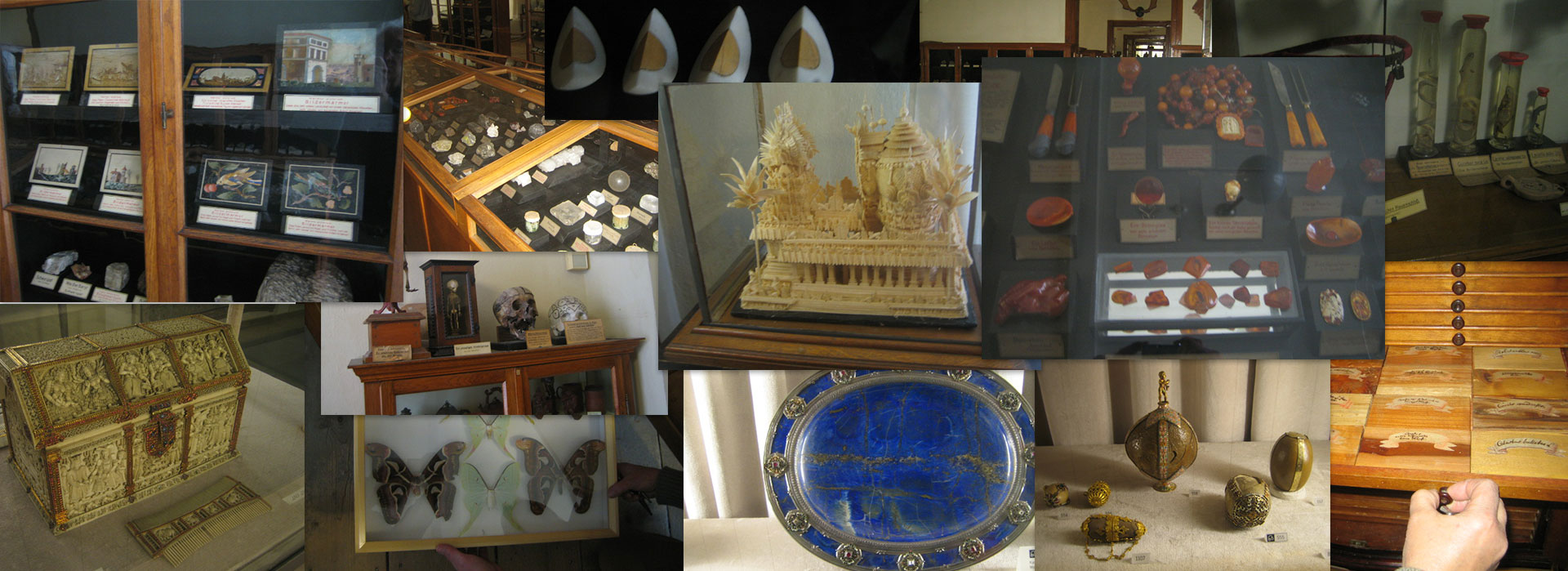
Here is a sample of photos from this German/Austrian wunderkammern tour:
img_6008.JPG
img_5899.JPG
img_0003.JPG

→ 1 CommentTags: Curio Cabinet · Dreams & Scenes · Funston Antiques · Introduction · Wonder Chamber · Wunderkammer · Wunderkammern